Where is Costa Brava, and what should you expect when you get there?
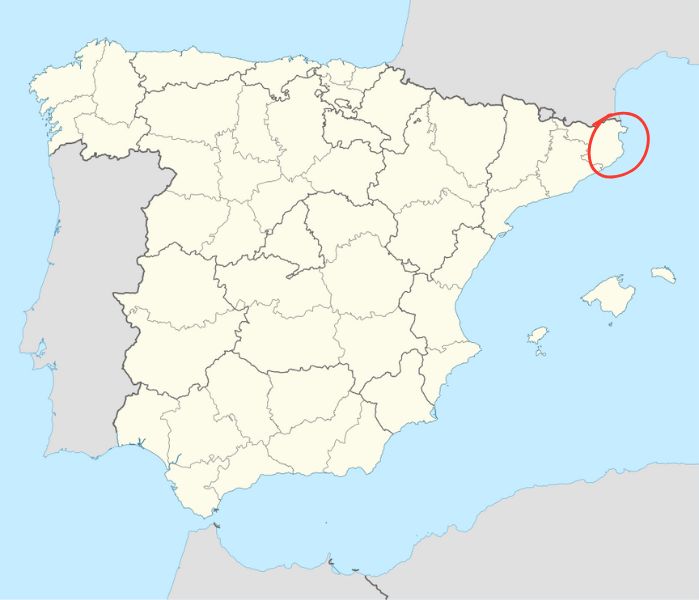
The location of the Costa Brava. Adapted from map of Spain by Roi González Villa licenced under CC BY-SA 3.0
You’ve probably heard the name before — maybe in a friend’s holiday story or on a list of Spain’s top beaches — but still find yourself wondering: where is Costa Brava, exactly? And why does it come up so often when people talk about coastal holidays that aren’t too flashy, too built-up or too far off the radar?
The Costa Brava is one of those places that quietly sticks in the minds of people who’ve been, even if it doesn’t shout about itself. It’s close enough to Barcelona to make sense logistically, yet different enough in pace and feel to stand on its own. With cliff-backed coves, hilltop villages and pine forests sloping down to the sea, it offers a kind of coastal Spain that feels more local than packaged — and a little easier to breathe in.
In this guide, we’ll explain exactly where the Costa Brava is, what defines it, how to get there, and why it’s worth considering for your next trip.
Where is Costa Brava located in Spain?
Costa Brava is located in the north-east corner of Spain, in the autonomous region of Catalonia. It runs along the Mediterranean coast, starting roughly at the town of Blanes and stretching all the way to the French border near Portbou. That’s a distance of around 200 kilometres, give or take a few rocky headlands and hidden coves.
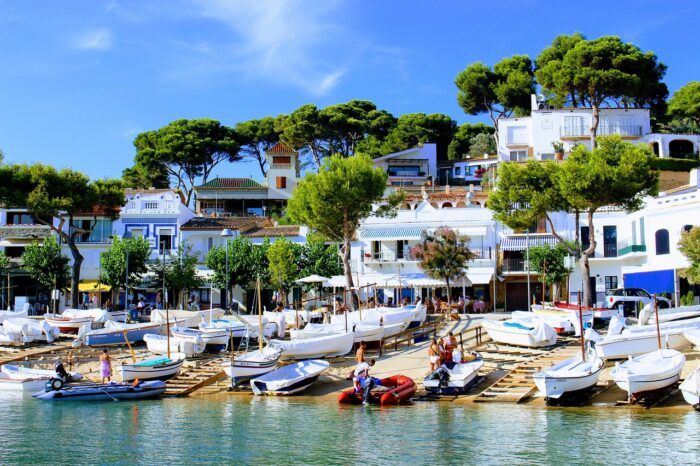
Boats on the beach at Llafranc. Photo by lloydcl2.
To the south, it sits just above Barcelona, separated by a more developed section of coast called the Maresme. To the north, it rubs shoulders with the Pyrenees and France, with some of the most dramatic landscapes found near Cap de Creus — a wild headland that feels more like a national park than a holiday spot.
Inland, Costa Brava rises gently towards the Empordà plain, then more steeply into forested hills and medieval villages. It’s this proximity between beach and countryside that gives the region its distinctive feel — you can be eating grilled fish by the sea at lunch and walking among olive trees or vineyard slopes by late afternoon.
The closest major cities are:
- Girona: About 30–45 minutes inland from the coast
- Barcelona: Around 1–2 hours south, depending on your destination
In short, while the Costa Brava is very much part of Spain, it has a very different identity due to being part of Catalonia and its vicinity to southern France.
What does “Costa Brava” mean?
The name Costa Brava translates directly to “rugged coast” or “wild coast” — and it’s not just a poetic flourish. The term was first used in the early 20th century by local writers and journalists to describe the dramatic cliffs, rocky outcrops, and rough waters that define much of the shoreline. It stuck, and by the 1950s, tourism officials had adopted it formally as a name for the region.
Unlike some of Spain’s smoother, sandier coastlines, the Costa Brava is full of contrast. One minute you’re on a long, gently curving beach; the next you’re standing on a cliff path looking down at a tiny cove only reachable by foot. This variety — forest meeting sea, villages perched on hills, waves breaking against rock — is exactly what gives the region its character.
Despite its popularity with tourists, many parts of the Costa Brava still feel raw and undeveloped. You’ll find modern resorts, yes, but you’ll also find coastal footpaths, crumbling watchtowers, quiet pine groves and fishermen’s huts tucked into hidden corners. The name still fits — it’s a place that feels just a little untamed.
Key towns and areas to know
If you’re just getting to grips with where Costa Brava is, understanding which towns define the region helps make sense of the map — and how different the feel can be from place to place. Here’s a quick guide to some of the main towns and areas, heading roughly from south to north.
Blanes
Technically the southern gateway to the Costa Brava. It has a resort feel but also a nice old quarter and a long beach. Popular with Spanish holidaymakers.
- Best for: First-timers, families, convenience
- Feels like: The bridge between Barcelona and the wild coast
Tossa de Mar
A photogenic town with a medieval walled old quarter, cobbled streets and a walkable beach. It’s romantic without being remote, and easy to get to by public transport.
- Best for: Couples, short stays, historic charm
- Feels like: A postcard with a bit of substance
Platja d’Aro & Palamós
Busy in summer, these towns have long beaches and lively seafronts. More built up, with plenty of villa rentals, shops and nightlife.
- Best for: Groups, active holidays, convenience
- Feels like: A functional base with good access
Calella de Palafrugell & Llafranc
Charming, small seaside towns with whitewashed buildings, calm coves and great walking trails. Stay here if you’re after a quieter pace.
- Best for: Slower travel, short walks, sea views
- Feels like: The Costa Brava most people dream of
Begur
A hilltop town a little inland, with excellent access to multiple beaches below — like Aiguablava and Sa Tuna. Upmarket but not flashy.
- Best for: Style-conscious travellers, beach hopping
- Feels like: A base for those who want it all
L’Escala & L’Estartit
Further north, these towns are family-friendly and practical. L’Escala is known for its anchovies; L’Estartit for diving near the Medes Islands.
- Best for: Families, food lovers, watersports
- Feels like: Easygoing and underrated
Cadaqués
Remote, distinctive, and full of character. Accessible via a winding mountain road, this fishing village was Salvador Dalí’s long-time home and remains a creative haven.
- Best for: Couples, off-season stays, art and atmosphere
- Feels like: Somewhere with its own rules
Portbou
Almost on the French border, this tiny town sees fewer visitors and has a slightly offbeat feel. More transit than tourist, but still worth a look.
- Best for: Quiet escapes, cross-border trips
- Feels like: The edge of Spain
How to get there
Once you know where to find the Costa Brava, the next step is working out how to get there — and it’s easier than you might think. Despite its rugged feel, the region is well connected by road, rail and air, making it accessible whether you’re flying in, driving across Europe, or already visiting other parts of Spain.
By air
Girona–Costa Brava Airport (GRO)
The most convenient local airport. It’s small, efficient, and just 30–40 minutes from the coast by car. Popular with budget airlines, especially during spring and summer.
- Pros: Close to the coast, short transfers, fewer crowds
- Cons: Seasonal flights only — limited in winter
Barcelona El Prat Airport (BCN)
Larger and open year-round, with far more international connections. It’s around 90 minutes from southern Costa Brava towns like Tossa de Mar or Palamós.
- Pros: Year-round service, wide flight choice
- Cons: Longer transfer, especially to the northern coast
By car
Hiring a car is one of the best ways to explore Costa Brava. It gives you access to smaller coves, hilltop towns and inland villages that are hard to reach otherwise.
- From Barcelona: Around 1.5–2 hours depending on your destination
- From Girona: Usually 30–60 minutes
- Motorway access via AP-7, with well-signposted exits for key towns
- Note: Some beach areas have limited parking in high season
By train and bus
- Trains run from Barcelona and Girona to inland towns like Blanes, Figueres and Flaçà
- From there, local buses serve the coast, though they can be infrequent outside summer
- Good for reaching larger towns, less ideal for remote coves or inland villas
Insider tip
If you want to visit multiple towns or beaches, a hire car is highly recommended. For short breaks or single-base holidays, buses and taxis are enough — just check schedules carefully, especially out of season.
Why go? What makes the Costa Brava special
Once you know where the Costa Brava is, the next question is often why choose it over other parts of Spain? The answer comes down to a few things: the scenery, the slower pace, the sense of variety — and the feeling that you’re somewhere that hasn’t been completely overtaken by mass tourism.
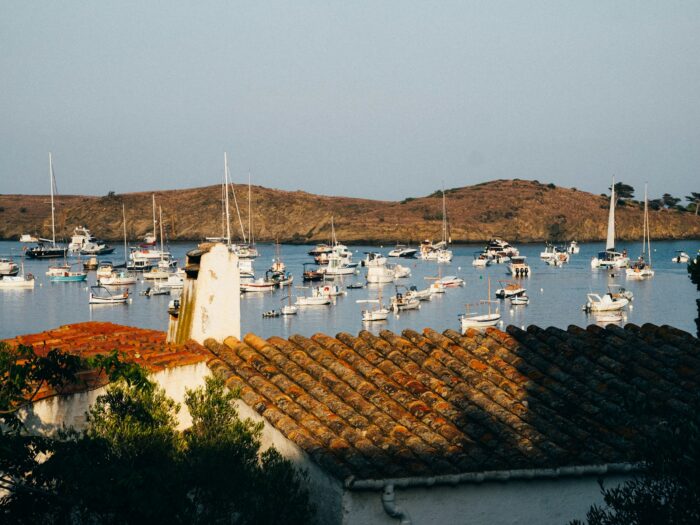
Salvador Dalí owned a house at Portlligat. Photo by Luca Dugaro
Diverse, dramatic coastline
The Costa Brava’s coastline is what draws most visitors — and it’s not hard to see why. Unlike long, uniform beaches elsewhere, this region is full of variety: hidden coves, steep cliffs, soft sandy stretches, and pine forests running right down to the sea. You can swim in one cove in the morning, hike to another for lunch, and still be back for dinner with a view.
Historic towns and Catalan culture
From medieval hill villages to coastal fishing ports, the region is rich in history and local identity. This is Catalonia, not just Spain — and that comes through in everything from the language (Catalan is widely spoken) to the festivals, food, and village traditions.
A strong food scene
The Costa Brava is serious about its food. Whether it’s fresh seafood on the seafront, a bottle of local Empordà wine, or a backstreet tapas bar, the region has options at every level. It’s also home to some of Spain’s most famous restaurants — including the legacy of El Bulli in Roses and its influence on the region’s approach to cuisine.
Slower, more flexible travel
You won’t find sprawling all-inclusive resorts or neon nightlife here. The Costa Brava is about flexible, independent travel — whether you’re in a rental car, staying in a villa, or walking between coastal villages. It’s easy to go at your own pace, whether that means daily hikes or long afternoons doing very little.
Something for everyone
Families appreciate the safe beaches and practical towns. Couples come for the atmosphere and quiet coves. Solo travellers find space to think and room to move. Walkers, cyclists, swimmers, food lovers — there’s enough variety here that you don’t need to pick just one version of a holiday.
When to visit
One of the things that makes the Costa Brava appealing is that it doesn’t rely on a single peak season. The weather, landscape and pace all shift throughout the year — and each season offers a slightly different version of the region. When you go depends on what kind of trip you want.
Spring (April to June)
This is a great time to explore the Costa Brava before the summer rush. Wildflowers are out, the sea starts to warm up, and towns are busy enough to feel alive without being crowded.
- Ideal for: Walkers, early-season swimmers, relaxed travel
- Bonus: Accommodation is easier to find and often cheaper
Summer (July and August)
High season brings the hottest weather, the busiest beaches, and the liveliest towns. It’s the time for long swims, late dinners, and full-on beach holidays — but also traffic, full bookings and higher prices.
- Ideal for: Families, beach lovers, festival-goers
- Tip: Book well ahead, especially for villas or seaside towns
Autumn (September to October)
Often overlooked, early autumn is one of the best times to visit. The sea is still warm, the crowds have thinned, and you can often get last-minute deals on places to stay.
- Ideal for: Couples, food travellers, quiet escapes
- Weather: Still warm and sunny, especially in September
Winter (November to March)
The coast slows right down in winter, with some beach towns almost shutting up shop. But it’s a great time for slow travel, coastal walks, photography and longer stays.
- Ideal for: Writers, off-season explorers, those who don’t need sunbathing
- Weather: Mild, with crisp mornings and cooler nights
Final notes
So where is Costa Brava? It’s in north-east Spain, just above Barcelona, stretched along a coastline where pine-covered hills slide into quiet coves and old fishing towns sit alongside sandy beaches. But that’s just the start.
What makes the Costa Brava more than just a dot on the map is its mix of landscapes, traditions and pace. It’s a region where you can swim in the morning, visit a medieval village in the afternoon, and eat grilled prawns by the harbour at night. It works for a week, a weekend or a wandering road trip — and suits just about any kind of traveller, once you find the right base.
Whether you’re planning a villa holiday, a walking trip, or just wondering what else Spain has to offer beyond the usual hotspots, the Costa Brava is closer, quieter and more varied than you might expect. Now that you know where it is, the rest is just about choosing how you want to experience it.