Clear skies, bare landscapes and simple routines define the Costa Brava in its quietest season.
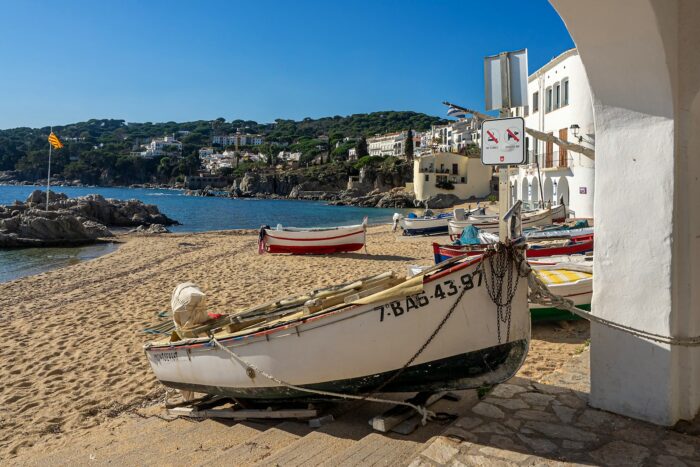
A boat on the beach at Calella de Palafrugell. Photo by Manuel Torres Garcia.
By the time December arrives, the Costa Brava has shed whatever was left of summer. The leaves are mostly gone, though the pines stay green. The sea has cooled. The air is crisp. There are no queues, no traffic, and no noise — just the sound of waves on damp sand, a few dog walkers on the beach, and fishermen in waterproofs, casting quietly into the wind.
You might find yourself standing on the promenade in Platja d’Aro, wrapped in a jacket, watching the sea. It looks different now — steel-grey on some days, almost glassy on others. People don’t come to sunbathe. They come to walk, to breathe, or just to look. There are sometimes still swimmers — either hardy or foolish, who knows — but they’re the exception. Most sit on a café terrace with a coffee, zipped up against the cold, watching the horizon like it might answer a question.
This is a coastline that empties slowly. Some places wind down from mid-October. Others carry on through the first weeks of November, and people withdraw a little. You start to notice the architecture again — the outlines of old houses, the curve of a quiet cove, the way light reflects off wet stone.
But winter doesn’t mean lifeless. In many towns, it just means that life moves indoors. Fires are lit. Kitchens warm up. Locals return to routines. The silence feels chosen and it brings its own kind of clarity.
The real winter weather
Winter on the Costa Brava doesn’t bring deep snowdrifts – not usually, anyway – or weeks of rain, but it does bring its own kind of cold — often sharper than people expect. Days are shorter, the sun is low, and if the wind picks up, you’ll feel it in your bones.
In Alt Empordà, winter is defined by the tramuntana — a dry, northerly wind that can blow for days. It strips the clouds from the sky, scrubs the air clean, and makes everything feel brighter and colder at the same time. It whistles through empty streets, rattles shutters and makes outdoor cafés feel like a dare. But when it stops, it leaves behind the clearest skies of the year — the kind of visibility that makes the Pyrenees look close enough to touch.
Further south, in places like Platja d’Aro, the winter weather is milder. You still need a coat, but there are many calm, still days where the sea lies flat and the air feels almost spring-like in the sun. Rain is less frequent than in autumn, and when it does arrive, it tends to be brief and direct — the kind that clears quickly, leaving everything shining.
Average daytime temperatures hover around 8 to 12 degrees, though it often feels colder in the shade or early morning. Inland, especially in the foothills, it can drop below freezing at night. Frost clings to fields and car windscreens. In the highest parts of the region — or on a clear day from the coast — you can see the snow line edging its way down the mountains.
The light is the standout feature. It’s low, white, and clean — particularly in the middle of the day, when it bounces off sea and stone. It doesn’t warm you, but it sharpens everything. Colours feel more exact. Edges more defined. This is a season that doesn’t soften anything — it just makes it more visible.
Who stays, and what they do
By January, the Costa Brava belongs almost entirely to the people who live here. There are no queues at the bakery, no traffic on the coastal roads, and no wait for a table at lunch. The pace has slowed, but it hasn’t stopped. In some towns, life simply folds inward — quieter, yes, but still ticking along.
Walk down to the beach in Platja d’Aro on a weekday morning and you’ll still find people — just not the kind who’ve come for sun and sangria. There are dog walkers, runners in long sleeves, and the occasional older couple with hands in their coat pockets, moving slowly along the waterline. A few locals still swim, more out of habit than bravado. You’ll sometimes see someone walking calmly into the sea while the rest of the beach is zipped into down jackets. No one makes a scene. It’s just what they do.
Fishermen set up near the rocks, rods anchored in the sand, waiting in silence. In the cafés that stay open year-round, regulars sit with coffee and newspapers, coats draped over the backs of chairs, catching up on local gossip or watching the street. In towns like Blanes, Palamós, and Sant Feliu de Guíxols, the winter routine is a visible thing — kids going to school, shutters going up mid-morning, deliveries made by van rather than lorry.
Some shops close, but the essentials stay open. Supermarkets, hardware stores, butchers, and bakeries still do steady business. The Sunday markets are smaller but somehow better — less frantic, less performative. You can talk to the people selling you artichokes or cheese. You can ask where something’s from and actually hear the answer.
The Costa Brava in winter isn’t empty. It’s just quieter, more local, and more honest about what it is. If summer is a performance, winter is a conversation — and you’re more likely to be part of it.
Winter food and seasonal rhythms
The menus change long before the weather does. By early December, the salads and seafood platters of summer have disappeared, replaced by stews, slow-cooked meats, and soups you eat with a spoon and a piece of bread. In the small restaurants that stay open — especially inland or in lived-in coastal towns — the food becomes more local, more comforting, and more rooted in the season.
This is the time for escudella i carn d’olla, the classic Catalan winter stew with meat, bones, pasta and vegetables — rich and restorative. Canelons appear on family tables after Christmas, made with leftover roast meats and covered in béchamel. You’ll find xató, too — a cold-weather salad with endive, cod, anchovies and a nutty romesco-style sauce. Not every place serves it, but the ones that do tend to get it right.
In the markets, the change is clear: piles of artichokes, bunches of calçots, local citrus, early chard and spinach, and plenty of dried beans. If you’re here in January or February, you might get invited to a calçotada — the seasonal ritual of grilling calçots over open flames, served blackened with romesco, followed by grilled lamb and red wine. It’s messy, smoky and entirely unpretentious.
Wines shift too. Where summer calls for chilled whites and rosés, winter settles into Empordà reds — often rustic, sometimes elegant, always better with food. A glass by the fire, or with a midday meal that runs a little longer than planned.
Most tourist-facing restaurants close for the season, but this is when the year-round places shine. You’ll see the same faces, the same plates, the same local wines. There’s less choice, but more intention. You eat what’s available, not what’s marketed. And that, in winter, feels right.
What’s open, what’s not
Winter lays the Costa Brava bare — not just in the landscape, but in the structure of its towns. You quickly see which places are built for tourism, and which are built for life. The difference isn’t subtle. One shuts down; the other carries on.
In Tossa de Mar, Calella de Palafrugell, or Begur, many shops and restaurants close completely from November to March. Windows are shuttered, signs removed, and there’s little to no street life on weekdays. Even the hotels are mostly dark. These places don’t pretend to be open — they simply hibernate.
But not everywhere goes quiet. Platja d’Aro, Palamós, Blanes, and parts of Sant Feliu de Guíxols stay awake. They’re not quite buzzing — nothing is — but they’re still functioning. You’ll find cafés serving breakfast, supermarkets open as usual, hardware shops, hairdressers, and plenty of locals going about their day. Restaurants may have shorter hours, or work only on weekends, but there’s still somewhere to sit down and eat a proper meal.
Hotels are fewer, but some remain open year-round — often catering to cyclists, walkers, or older guests escaping the colder climates inland or further north. Family-run hotels, modest apartments, and the occasional boutique place all tend to offer lower prices and fewer frills — but also peace, space, and flexibility.
This is the season of no reservations — in restaurants, on roads, or at viewpoints. You can decide on lunch at the last minute. You can walk into a museum and have it to yourself. You can drive the coastal road without being stuck behind a caravan. And when something’s closed, it’s rarely a problem. There’s no rush. You just try the next place — or go home and cook.
The winter landscape
What winter takes away in colour, it gives back in clarity. The landscape feels stripped back, quieter, easier to read. You see more — not just because the trees are barer or the crowds gone, but because there’s less in the way.
The sea changes first. Gone are the beach umbrellas and sunbathers. Now it’s just the water and the light. Some days it’s a dark, heavy blue; other days, flat and almost silver. In early morning or late afternoon, you might see a fisherman out on the rocks, motionless, or a dog trotting across the sand. There’s no soundtrack — just waves, wind, and the occasional gull.
The cliffs and headlands, usually overlooked in the heat of summer, are starker now. You notice the shape of them — how they drop, how the footpaths bend around them, how exposed they really are. Walks feel different. The Cami de Ronda isn’t just a trail — it’s an experience in weather, light, and space. You might do a whole stretch without seeing anyone, just the sound of your shoes on gravel and the wind in the pines.
Inland, the Empordà fields are bare. The vineyards are reduced to black branches, neat rows of skeletons against an open sky. There’s a kind of beauty in the simplicity — the bones of the land visible now that everything else has receded. Birdlife changes too: herons, cormorants, gulls inland, storks if you’re lucky, and the occasional hawk circling over the fields.
The light is low and clean. The sunsets are short but often stunning — sharp golds and reds for ten or fifteen minutes, then gone. By five, the temperature drops. Towns start to glow from inside: yellow windows, smoke from chimneys, and the sense that everyone has moved inwards for the night.
It’s not a landscape for postcards. It’s one for walking through, slowly, with your hands in your pockets and no need to rush.
A quiet invitation
Winter doesn’t try to sell the Costa Brava. It doesn’t perform. It doesn’t push. If you’re here, it’s probably because you’ve chosen it — not for what it promises, but for what it lets you notice.
There are no events pulling you in, no crowds dragging you along. It’s a season of small things: a silent beach, a hot coffee after a cold walk, the comfort of a stew that’s been cooking for hours. The kind of pleasures that don’t announce themselves.
You see more of the locals now — not behind counters or serving drinks, but living their lives. The place belongs to them again. Children walk to school with scarves over their mouths. Neighbours greet each other in the bakery. Friends stop to talk in the street without traffic rushing past.
And the coast? It’s still there, still itself — just quieter. The views are better. The walking is easier. There’s room to breathe. The light is different, and so is the mood. You don’t feel the pressure to “do” anything.
That’s the real invitation. Not a holiday. Not a break. Just a slower, less filtered version of the Costa Brava — and a chance to be part of it, even for a little while.