A guide to the best resorts in Costa Brava according to your personal holiday style.
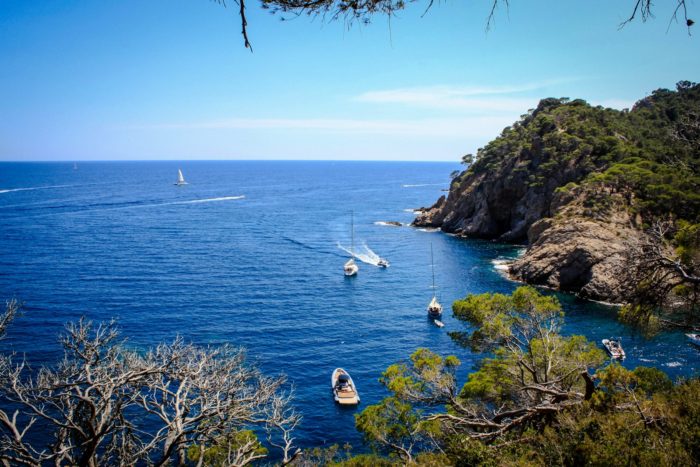
Boats in Tossa de Mar: Photo by Andrea Huls Pareja
The Costa Brava stretches for more than 200 kilometres, from Blanes to the French border. Along the way it changes constantly: rugged cliffs, sandy bays, fishing villages, resort towns, and wild headlands shaped by the wind. It is this variety that makes the Costa Brava so appealing — but for a first-time visitor it can also be overwhelming.
There isn’t one Costa Brava. There are dozens. A lively modern town with a long promenade feels nothing like a quiet whitewashed village tucked behind a beach. Some places are known for nightlife, others for history, others for their setting on cliffs and coves. The problem for newcomers isn’t whether the Costa Brava is worth visiting — it’s deciding where to base yourself.
Pick the right resort, and your first trip will feel effortless. You’ll have the right balance of beach, food, atmosphere, and access to the coast beyond. Pick the wrong one, and you may end up in a place that doesn’t at all suit your style.
This guide is written for first-time visitors who want to understand the options clearly. It looks at five of the best resorts in the Costa Brava, each with a different character, and explains what you can expect from them. By the end, you should know not just where to stay, but which Costa Brava will feel like the right one for you.
Tossa de Mar — history and atmosphere
If you picture the Costa Brava as a mix of beaches and history, Tossa de Mar is the resort that delivers it in one place. The town curves around a wide sandy bay, watched over by the medieval walls of the Vila Vella, the only surviving fortified old town on the Catalan coast. From the beach you can see the towers rising above the cliffs, and from the towers you can look out across the Mediterranean. Few places capture the idea of the Costa Brava so completely.
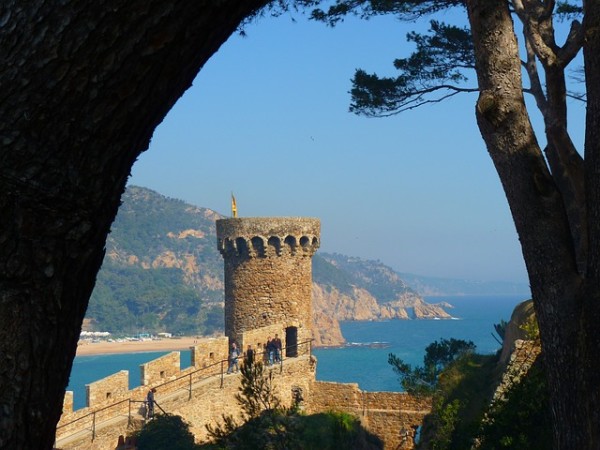
For a first-time visitor, Tossa offers balance. The main beach is long and sandy, safe for families and lively enough for a week by the sea. The old town has cobbled streets, restaurants tucked into stone houses, and viewpoints that make evening walks memorable. There are enough hotels and apartments to give choice, but the town remains compact and easy to explore on foot.
It isn’t just the centre that matters. Around Tossa, smaller coves such as Cala Pola and Cala Giverola can be reached by boat or coastal paths, giving you a taste of the wilder Costa Brava without leaving town. This makes Tossa a useful base: you can stay in comfort, but still get a sense of the coast beyond.
The downsides are mostly about popularity. In July and August the beach fills quickly, and parking is limited. Nightlife exists but is limited to bars and a few clubs — it’s not the resort for those chasing a party. But for many first-time visitors, that’s exactly the appeal. Tossa de Mar offers a manageable, picturesque introduction to the Costa Brava — one that shows off both its history and its shoreline.
Platja d’Aro — modern, lively, accessible
If Tossa de Mar feels historic, Platja d’Aro is its opposite: modern, lively, and built around convenience. The main attraction is a long, straight sandy beach backed by a promenade that runs for more than two kilometres. Behind it, the town spreads out with hotels, shops, bars, and restaurants, giving it the feel of a place designed for visitors. For a first-timer who wants everything in one spot, it’s hard to beat.
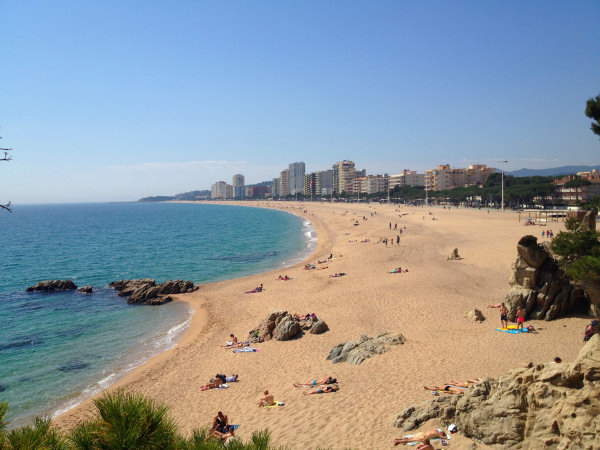
Platja d’Aro’s long sand beach. Photo by David Leigh
The appeal of Platja d’Aro is variety. The beach is wide and easy to access, but within walking distance you can also find rocky headlands and smaller coves like Cala Rovira and Cala Sa Cova. The town itself has supermarkets, fashion chains, bakeries, and late-night ice cream shops, so you never need to travel far for anything. Families like it for the facilities and space; younger visitors enjoy the nightlife, which is busy without being as full-on as Lloret de Mar.
It’s also one of the most accessible resorts. Platja d’Aro sits roughly in the middle of the Costa Brava, making day trips north or south straightforward by car. Public buses link to Girona and Barcelona, though a car gives much more freedom. For first-time visitors who want a base that allows exploration as well as comfort, the location is a real advantage.
The trade-off is character. Platja d’Aro is practical rather than picturesque. You won’t find cobbled old towns or whitewashed houses here, and some visitors find it too commercial. But if your idea of a good first trip is a place where the beach is on your doorstep, the restaurants are plentiful, and nothing is difficult, Platja d’Aro does exactly what a resort should.
Calella de Palafrugell — authentic and scenic
For many visitors, Calella de Palafrugell is the postcard image of the Costa Brava. A small former fishing village, it sits on a low stretch of coast where whitewashed houses open directly onto small sandy beaches. Wooden boats are pulled up on the sand, narrow lanes wind behind the seafront, and restaurants set tables under arcades facing the water. For a first-timer looking for charm and authenticity, Calella is hard to improve on.
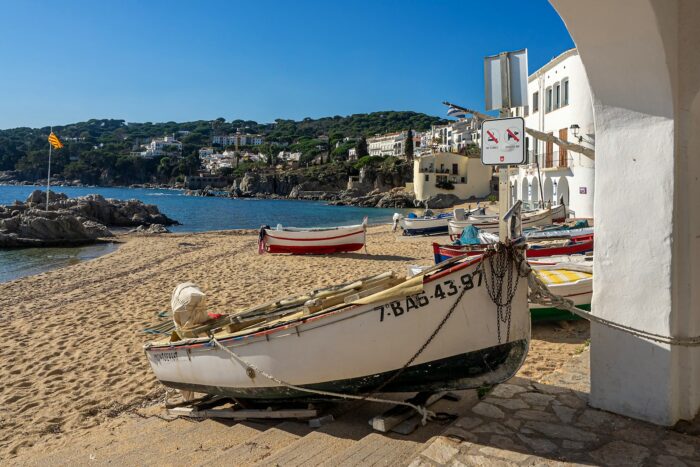
A boat on the beach at Calella de Palafrugell. Photo by Manuel Torres Garcia.
The appeal lies in its scale. Calella is compact, and you can walk from one end to the other in fifteen minutes. Each small bay feels different — from the family-friendly Port Bo beach in the centre to the quieter El Golfet on the edge of town. In summer the coves fill quickly, but outside peak weeks there’s space to enjoy the beaches and the sea without feeling crowded.
Calella also makes a good base for short coastal walks. The cami de ronda leads north to Llafranc, another small resort with a wide beach and a relaxed feel, and south towards rugged headlands and pine woods. This gives first-time visitors the chance to experience the wilder Costa Brava without needing a car.
The main limitation is size. Calella has only a handful of hotels, most of them small or family-run, and apartments fill up quickly in summer. There’s no large nightlife scene, and after dinner the town goes quiet. For some, that’s exactly the attraction. Calella de Palafrugell offers a softer, more traditional introduction to the Costa Brava — the kind of place where a first visit often leads to many more.
Cadaqués — artistic and remote
Towards the north of the Costa Brava lies Cadaqués, a whitewashed town that feels both part of Catalonia and apart from it. Reached only by a winding mountain road, it has the atmosphere of somewhere slightly cut off, which for many visitors is part of the appeal. For a first-timer who wants more than just beaches, Cadaqués offers character in abundance.
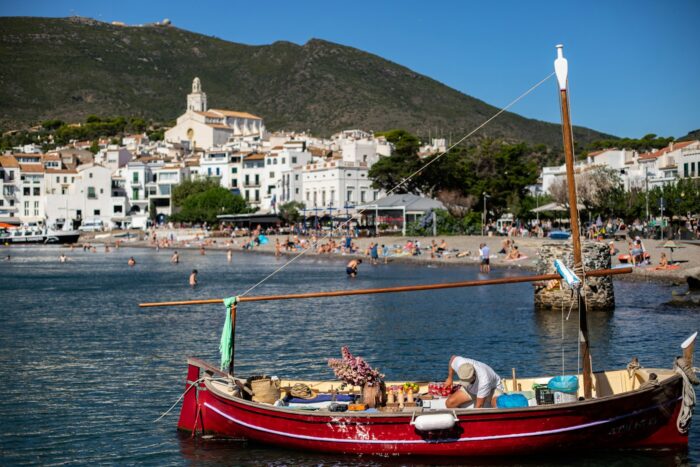
Above the whitewashed houses of Cadaqués stands the church tower. Photo by David Monje
The town curves around a rocky bay, its narrow streets paved with slate and its houses painted bright white. Fishing boats still anchor in the harbour, but the town is best known for its artistic heritage. Salvador Dalí lived and worked nearby in Portlligat, and other artists and writers were drawn here by the sharp light and remote setting. Walking through the town, past galleries and studios, you sense that legacy everywhere.
Cadaqués is not a classic beach resort. The shoreline is rocky, with small pebble coves rather than long stretches of sand, though the water is clear and good for swimming. The surrounding Cap de Creus Natural Park offers dramatic walks and viewpoints, with twisted rocks and windswept hills that feel very different from the softer coast further south.
The downsides are practical. The access road is slow and winding, which makes day trips elsewhere less appealing. Accommodation leans towards boutique hotels and apartments, and prices can be higher than in other towns. But for visitors who want their first Costa Brava stay to feel distinctive, Cadaqués leaves a lasting impression. It shows the wilder, more artistic face of the coast — and that first encounter often defines how people remember the region.
Lloret de Mar — nightlife and energy
If your idea of a first holiday on the Costa Brava is about nightlife and activity, Lloret de Mar is the resort that fits. It’s the liveliest town on the coast, known for its big hotels, late-night bars and clubs, and a constant sense of movement. For younger visitors, groups of friends, or anyone who wants energy from morning to night, Lloret delivers it in full.
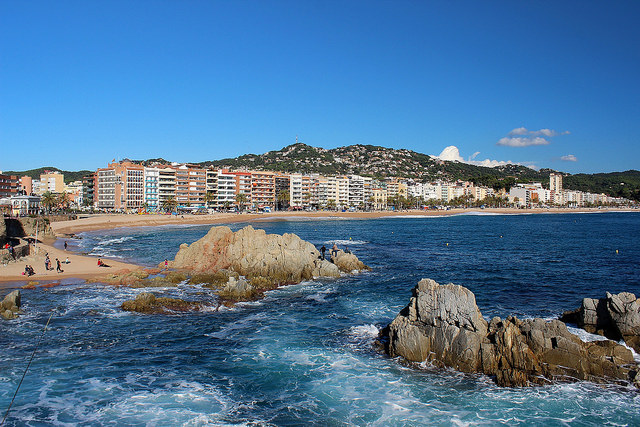
The main beach in Lloret de Mar. Photo by Albert Torelló
The main beach is long and sandy, lined with a promenade of cafés, restaurants and ice cream shops. Behind it, the town spreads out with shopping streets, arcades, and terraces where music spills into the night. By day, visitors swim, sunbathe, or try water-sports; by night, the focus shifts to bars, karaoke, and clubs that run until dawn.
There’s more to Lloret than its party reputation, though. A short walk leads to smaller coves such as Cala Boadella or Fenals Beach, which feel far quieter. The Santa Clotilde Gardens, laid out in the early 20th century above the sea, offer a surprising touch of elegance. Families also use Lloret as a base, drawn by the wide range of hotels and activities.
Still, the town’s character is dominated by its nightlife. For a first-time visitor who dreams of quiet evenings, it can feel overwhelming. For those who want a holiday full of noise, crowds, and never-ending options, it feels exactly right. Lloret de Mar shows one extreme of the Costa Brava — a resort that never really sleeps, and one that leaves a first impression unlike anywhere else on the coast.
How to choose your first base
For a first-time visitor, the hardest part of planning a Costa Brava holiday is not whether to go, but where to stay. Each resort offers something different, and the best choice depends less on guidebook rankings than on what you want from your first trip.
- Tossa de Mar is ideal if you want history alongside a good beach — a resort that feels picturesque but manageable.
- Platja d’Aro works best if you prefer convenience: long sandy beaches, plenty of hotels and shops, and an easy base for day trips.
- Calella de Palafrugell is for those who want atmosphere and charm, even if the choice of hotels is small.
- Cadaqués offers a more distinctive introduction, with its artistic legacy and wild setting, but it’s further from the rest of the coast.
- Lloret de Mar is for visitors who want energy above all else — nightlife, bustle, and a wide choice of activities.
The good news is that the Costa Brava is compact. Even if you pick one base, day trips to other towns are usually straightforward by car, and in some cases by bus or boat. Many first-time visitors end up exploring beyond their resort, discovering both the quieter and the livelier sides of the coast.
The key is to match the place to your own style. If you think about what matters most — beaches, atmosphere, history, nightlife, or convenience — the choice becomes clearer. Your first base will shape how you see the Costa Brava, but it doesn’t have to define your only experience of it.
Your first Costa Brava stay
A first trip to the Costa Brava is always about discovery. The coast is long and varied, and whichever resort you choose will shape how you remember it. Pick Tossa and you’ll think of towers above the sea. Choose Platja d’Aro and it will be the sweep of a wide sandy beach. Stay in Calella de Palafrugell and you’ll carry away the memory of whitewashed houses and small coves. Cadaqués leaves its mark with light and remoteness; Lloret with its energy.
There isn’t a single “best” resort for everyone. What matters is choosing the right one for the way you like to travel. The good news for first-time visitors is that the Costa Brava rarely disappoints. Even if you stay in one place, the coast is small enough to explore further — and many people return, choosing a different resort next time.
Your first stay sets the tone, but it doesn’t have to be your last. The Costa Brava rewards repeat visits, and each resort shows you a different face of the same coastline. Wherever you begin, the important thing is that you start.