Catalan Tapas You Won’t Find in Madrid: 7 Local Bites Worth Seeking Out
July 1, 2025Catalan tapas show how the region’s food culture sets itself apart with bold, simple flavours.
Tapas might be one of Spain’s most exported ideas, but it doesn’t take long in Catalonia to realise things are done differently here. The basics are familiar — small plates, shared tables, no rush — but the food itself tells a different story. This isn’t just another tapas list. It’s a look at the dishes that locals in the north-east actually eat — ones you won’t usually find on a bar menu in Madrid.
Of course, you’ll still find the usual suspects, such as Spanish omelette, chorizo, and olives. But if you scratch beneath the surface — or step off the main square — you’ll start to notice dishes that belong squarely to Catalonia.
Catalan tapas aren’t really “tapas” in the traditional sense. They’re more likely to be rooted in home cooking, based on local ingredients, and adapted to bar culture over time. Simple, humble plates that reveal a lot once you know what you’re looking at.
If you’re heading to the Costa Brava or spending time in Girona, Begur or L’Escala, this is what’s worth ordering. Seven dishes that come from the region — and stay in the region — unless you know where to look.
What makes Catalan tapas different?
Catalan food has its own pace and personality. You won’t find heavy use of paprika or deep-fried everything. Instead, you’ll notice a lot of grilled vegetables, cured fish, olive oil, garlic, and seasonal produce. The ingredients often do the talking, and there’s less reliance on sauces to carry a dish.
Most of what’s now served as Catalan “tapas” wasn’t designed as bar food at all. These are home-cooked dishes that have made their way onto bar menus in smaller portions — not as snacks, but as a way to share and graze. You’re just as likely to find something cold and garlicky as you are a plate of something crisp from the fryer.
There’s also a language difference. While “tapas” is universally understood, in Catalonia you’ll sometimes see the words platets (little plates) or pica-pica (things to nibble). The idea is the same, but the flavour — and the history behind each dish — is distinctly local.
Pa amb tomaquet
It’s the simplest thing on the table, and probably the most important. Pa amb tomaquet — bread with tomato — is so basic it’s easy to overlook, but no meal in Catalonia feels complete without it.
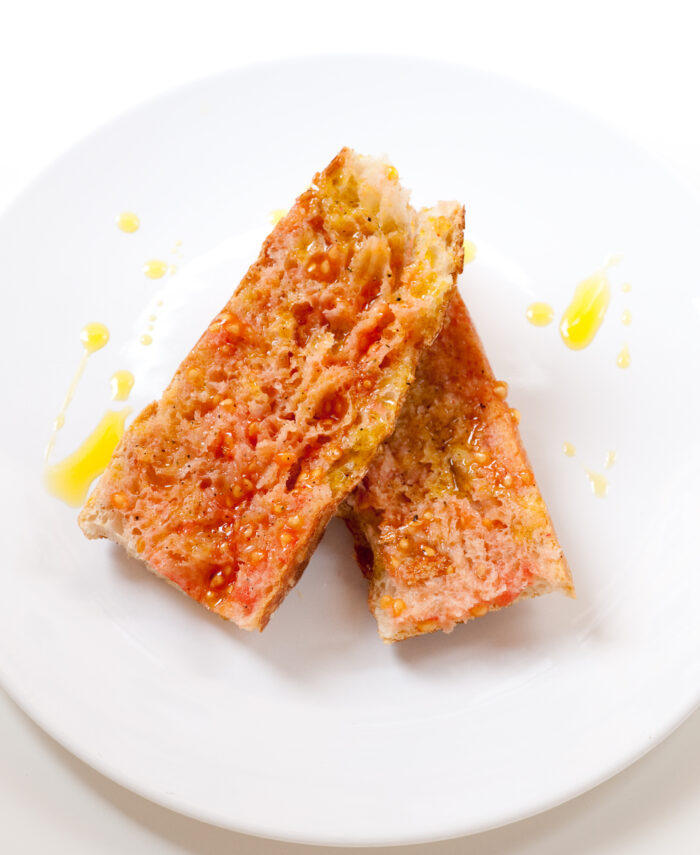
Pa amb tomaquet is a staple of Catalan cuisine. Photo by jules / stonesoup licensed under CC BY 2.0
The classic version starts with a slice of toasted country bread, ideally something sturdy with a rough crust. You can rub a cut clove of garlic lightly over the surface, then take a halved ripe tomato and squeeze it directly onto the bread. Add a pinch of salt then finish with a drizzle of good olive oil . That’s it. No spreading, no chopping, no extra seasoning.
You’ll find it served alongside cheese, charcuterie, or anchovies, but it’s just as often eaten on its own — especially as part of a pre-meal nibble or with a cold beer. Many bars will bring it without you even asking.
Done right, it’s crunchy, sweet, salty and just messy enough to remind you someone actually made it.
L’Escala anchovies
If you think you don’t like anchovies, you probably haven’t tried the ones from L’Escala. This small coastal town on the Costa Brava has been curing anchovies for centuries, using a method introduced by the Greeks when they founded nearby Empúries in the 6th century BC. The Romans carried on the tradition, and it stuck.
The anchovies are cured in sea salt, packed into barrels and left to age slowly. After several months, they’re cleaned, filleted by hand, and usually packed in oil for preservation. The result is firm, savoury and slightly sweet, with none of the harsh saltiness you get from cheap tinned versions. The texture is meaty, not mushy. You can taste the care that’s gone into each one.
You’ll often see them served on their own with a drizzle of oil, or laid across a slice of pa amb tomaquet. They also pair well with olives, manchego, or escalivada. In L’Escala itself, several family-run producers still cure anchovies the traditional way — and some offer tastings if you’re in town.
Escalivada
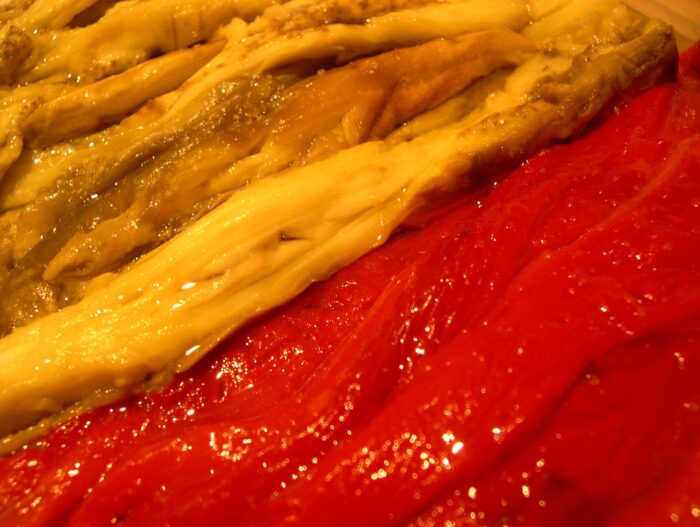
Escalivada is one of those dishes that seems almost too simple — until you taste it. At its core, it’s just grilled vegetables: red peppers, aubergine and onions. But when it’s done properly, over flame or hot embers, the result is smoky, silky and deeply satisfying.
The name comes from the Catalan verb escalivar, meaning “to cook in ashes” — a nod to its traditional preparation over open fire. These days, it’s often roasted in ovens, but the best versions still carry that subtle charred flavour that makes it more than just a cold salad.
Once cooked, the vegetables are peeled, sliced into strips, and dressed simply with olive oil and salt. Sometimes it’s served on its own; other times it comes with anchovies laid across the top. Either way, it’s eaten at room temperature and usually arrives on a small plate, ready to scoop up with bread or fork.
You’ll find escalivada in bars across the Costa Brava, especially in more traditional places or on daily specials boards. It’s a staple of Catalan home cooking — clean, honest, and ideal with a glass of chilled white or vermut.
Seitons
Seitons are fresh anchovies — but forget everything you know about the tinned kind. These are lightly cured in vinegar, then dressed with olive oil, garlic and parsley, sometimes with a touch of lemon. The result is clean, sharp, and surprisingly delicate.
In Spanish, they’re often called boquerones en vinagre, but in Catalonia they go by their Catalan name: seitons. The vinegar “cooks” the fish, turning the fillets pale and firm. They’re usually served cold, laid flat on a small plate, and eaten as a snack with drinks. Some bars serve them on a slice of potato or toast, others offer them with olives or even crisps.
You’ll find them in both traditional and modern bars, and they’re often part of a simple pica-pica spread. Good seitons are fresh, not too vinegary, and have a clean finish. If you’re in a seaside town and they’re on the menu, order them.
Fuet
Fuet is the kind of thing you’ll see hanging behind the bar, on the table at breakfast, or in someone’s shopping bag on market day. It’s a thin, dry-cured pork sausage, usually eaten sliced and at room temperature, with a piece of bread or a glass of red wine.
It comes from inland Catalonia, especially the region around Vic, and is made with pork, salt, garlic and black pepper. Unlike chorizo, it contains no paprika or spice. The flavour is mild, slightly sweet, and very moreish. The white casing you see on the outside is natural mould from the curing process — not something to peel off.
Fuet is sold everywhere: butchers, markets, supermarkets, corner shops. It doesn’t need to be cooked, doesn’t need refrigeration, and doesn’t try to be fancy. You just slice it and eat it. In tapas bars, it’s often served in thick chunks alongside cheese or olives. Sometimes it’s draped on top of pa amb tomaquet, but it’s just as good on its own.
If you want a taste of everyday Catalan food culture, this is it — unpretentious, full of flavour, and always close to hand.
Palamós prawns
Palamós prawns are famous across Catalonia, and for good reason. Caught just off the coast of this Costa Brava fishing town, they’re known for their deep red colour, intense flavour and firm texture. You’ll find them on menus from Girona to Barcelona, often with a price tag to match.
What sets them apart is how and where they’re caught. The waters off Palamós are deep and rocky — ideal conditions for Aristeus antennatus, the species of prawn found here. They’re usually fished in small boats, landed daily, and sold at the local fish market, where chefs and restaurants snap them up straight off the quay.
They’re almost always cooked very simply: grilled whole with a sprinkle of sea salt and a drizzle of olive oil. No sauces, no fuss — just pure prawn flavour. The heads are the best bit, rich and buttery, and most locals won’t leave a drop behind.
Palamós prawns aren’t cheap, and they’re not always served as tapas. But in the right bar or beachside restaurant, you might find a couple on a small plate — especially if you ask. They’re worth trying at least once while you’re on the Costa Brava, even if just to see what all the fuss is about.
Patatas bravas with allioli
Patatas bravas are one of the few tapas you’ll find all over Spain, but the version you get in Catalonia has its own character. It starts with crispy fried potatoes, cut into irregular chunks or cubes, golden on the outside and soft inside. What sets it apart is the sauce — or, more often, the sauces.
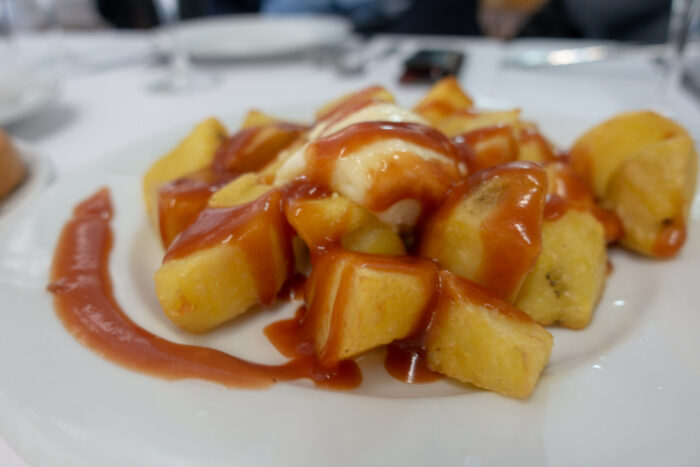
In Catalonia Patatas Bravas are sometimes made with allioli. Photo by Kent Wang licensed under CC BY-SA 2.0
In Catalonia, bravas are usually topped with a spicy mix of ketchup and mayonnaise, usually with a little chilli sauce for heat. Some bars serve the sauces separately on the side; others spoon them straight over the top. It’s casual food, and there’s no strict rule.
But many places take it a step further by swapping the mayo for allioli — a garlicky mayonnaise that gives the dish a serious kick. Traditional allioli was made by hand with just garlic, olive oil and salt, but these days most versions are made with egg for a smoother, more stable texture. What matters is the flavour: strong, creamy, and unapologetically garlicky.
In some bars, you’ll get just allioli. In others, it’ll come alongside a spicy ketchup or tomato sauce. Every place does it differently — which is part of the fun.
Where to try them on the Costa Brava
You won’t need to go far to find tapas on the Costa Brava — but if you want the local stuff, it helps to know where to look. Tourist hotspots often have laminated menus and picture boards full of generic Spanish tapas. The good news is, just around the corner, there’s usually a bar doing it properly.
Girona
Girona’s old town has a strong food culture, from Michelin-starred restaurants to tiny bars hidden down side streets. Look out for places with handwritten menus, short lists of daily specials, and locals standing at the bar. Many offer small plates of fuet, pa amb tomaquet, or anchovies — even if they don’t call them “tapas”.
L’Escala
This is anchovy country, and it shows. There are a handful of long-established anchovy producers in town — some open for tastings — and plenty of bars serving their fillets simply with bread, tomato and oil. Look for Anxoves de L’Escala or Callol Serrats on menus, or buy a tin to take home.
Palamós
Seafood is the focus here, and the local prawns are the star. Head to a beachfront xiringuito or one of the more traditional restaurants just inland. You won’t always find prawns served as tapas — but some places will offer them grilled as a small plate or starter if you ask.
Begur and Calella de Palafrugell
These are good spots for well-curated pica-pica menus. Expect things like escalivada, allioli, seitons and fuet. Smaller, independent places tend to keep things seasonal and local. If the place looks a bit too polished, or if the menu has pictures, you might be in tourist territory — but even then, you can often spot a few good dishes hiding in plain sight.
What to look for
Forget the word “tapas” for a minute and look for signs that the kitchen actually cares. Menus written in Catalan, specials on the chalkboard, locals ordering vermut or house wine, and no pressure to rush your order. The best places don’t necessarily advertise — they just cook well.
Final thoughts
You don’t have to eat everything on this list to get a taste of Catalonia — but knowing what to look for makes all the difference. These dishes aren’t flashy or complicated. They come from home kitchens, fishing villages and inland towns, and they’ve found their way onto bar menus not because they were trendy, but because they’re good.
There’s no need to obsess over finding the “best” place. Half the joy is in the small discoveries: a bar where the pa amb tomaquet is made with proper bread, or a quiet spot that serves seitons cold and sharp with a glass of vermut. Ask what’s local. See what’s on the blackboard. Go slow.
Catalan tapas might not look like what you’re used to — and that’s the point. They tell a different story, in a different language, one plate at a time.
Tags: Escalavada, Food, L'Escala anchovies, Pa amb tomàquet, Palamos prawns, Seitons, Tapas