Catalan desserts you’ve never heard of
October 7, 2025Traditional desserts are quietly resisting modern tastes in the kitchens where they were born.
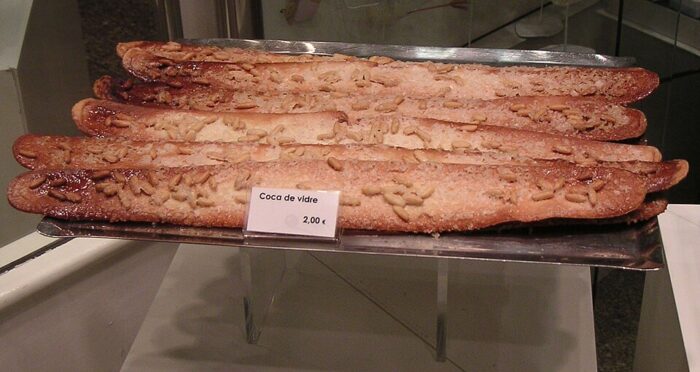
Coca de vidra for sale in Barcelona. Photo by Slastic
It begins, as so many good stories do in Catalonia, with a paper napkin and something sweet you didn’t ask for. Perhaps a waiter brings it with the coffee — a brittle shard of sugary pastry, or a spoonful of soft white pudding dusted with cinnamon. You hadn’t planned on dessert, but here it is. A quiet ritual, slipped between conversation and the bill. No flourish, no menu description. And yet, in that modest offering lies a whole world of tradition, memory, and local pride — especially if you know what you’re eating.
Mention Catalan desserts and most visitors will say crema catalana, maybe mel i mató or panellets if they’ve spent time here in autumn. These classics are deservedly celebrated. But Catalonia’s sweet repertoire runs far deeper than its most photographed dishes. Many are tied to specific festivals or towns, others only appear at certain times of year or are made at home by people who don’t call themselves chefs. Some are disappearing. Others survive quietly on bakery shelves and tavern menus, never making it into travel guides or Instagram reels.
This article is not about the obvious. It’s about the desserts you didn’t know to look for — the ones still whispered about in market queues or passed down in handwritten notes. To understand them is to understand something about Catalonia itself: practical, fiercely local, and quietly resistant to change. These are the Catalan desserts you’ve never heard of — and why they matter.
A culture told in sugar and smoke
To understand Catalan desserts, you need to understand how they fit into the rhythm of life here. This isn’t a cuisine built around indulgence for indulgence’s sake. Most sweets are seasonal, tied to religious festivals or agricultural cycles, and many have their roots in humble, rural kitchens. If they’re rich, it’s because they had to last. If they’re sweet, it’s often because sugar was used to preserve rather than decorate.
Catalonia’s pantry is distinct. Almonds, pine nuts, citrus peel, olive oil, local honey, anisette, even pork fat — these are the building blocks of many traditional sweets. You’ll see few dairy-heavy puddings or elaborate gateaux. Instead, desserts here are often flat, fried, or baked quickly, designed to feed many and made to share. They carry the imprint of many cultures: Moorish, Jewish, Roman, French, but always filtered through a Catalan lens.
Religious calendars play a central role. Lent, Easter, All Saints’ Day, Carnival — each brings with it a suite of sweets specific to the moment. They weren’t always thought of as “dessert”, either. Many were eaten as afternoon snacks (berenars), morning treats, or with wine at the end of a meal. Some doubled as portable energy sources for farmers and fishermen.
Unlike the fine patisserie traditions of nearby France, Catalan desserts are often rustic and communal. Some are sold in bakeries, but many remain the preserve of home kitchens, made by women who never needed a recipe book. As tourism has grown, menus have streamlined. But if you step off the tourist trail — into a village bakery in the Empordà, or a small-town fonda — the old sweets still turn up, stubbornly resisting the drift toward the international and the Instagrammable.
Coca de vidre: sugar, oil and flame
If there is a Catalan dessert hiding in plain sight, it’s coca de vidre. You’ll find it in bakeries from Figueres to Lleida, often stacked in modest piles beside heartier cocas topped with peppers or sardines. But unlike its savoury cousins, coca de vidre is light, flat, and sweet — so thin it almost disappears in the hand. Its name means “glass cake”, a reference to the way the sugar on its surface melts and caramelises into a shiny, brittle glaze that cracks like sugar glass when bitten.
It’s made from little more than flour, olive oil, sugar and pine nuts. The dough is stretched impossibly thin, brushed with oil, sprinkled with sugar, and fired quickly in a hot oven — traditionally a wood-burning one. Sometimes anisette is splashed over the top as it comes out, giving it a fleeting hint of liquorice that fades almost as soon as you taste it.
This is not a dessert designed to impress. It’s one you eat with your fingers, maybe still standing in the bakery or while walking home. And yet there’s something quietly beautiful about it — the balance of crunch and chew, the way the sugar shatters, the uneven golden blisters from the oven. It’s the kind of thing a grandmother might give a child to keep them quiet for a minute. No one makes a fuss about it, which is exactly the point.
Despite its simplicity, coca de vidre is hard to replicate at home — too many domestic ovens can’t reach the fierce heat needed to blister it properly. It’s at its best warm, just out of the oven, when the sugar is still soft and the edges haven’t started to bend. In many places, it’s eaten with ratafia or a small anisette, especially around local festivals.
It rarely makes it onto tourist menus, perhaps because it lacks the theatrical richness of a crema catalana. But speak to anyone who grew up here and they’ll tell you: this is the taste of an ordinary Catalan afternoon.
Postre de músic: the working man’s pudding
In its simplest form, postre de músic is a handful of dried fruit and nuts served with a splash of sweet wine. It doesn’t sound like much — and that’s exactly the point. This is a dessert born not from indulgence but from what was on hand. Figs, raisins, walnuts, almonds, hazelnuts — whatever had been dried or gathered, whatever the pantry held — dressed with a glug of moscatell or sweet ranci wine. No cooking. No ceremony. Just a quiet finish to a meal.
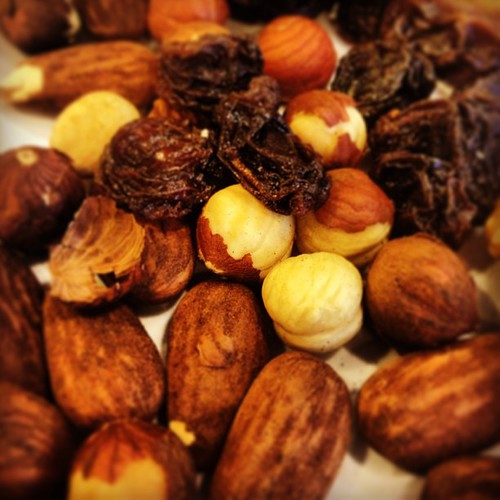
Postre de music. Photo by Santi Garcia licensed under CC BY 2.0
The name is curious. One version suggests it comes from the idea that itinerant musicians — hired for village dances or religious processions — were often paid not in money but in nuts and a cup of wine. Another theory links it to the small bags of nuts once sold at village fairs, the kind a musician might snack on between sets. Either way, it’s a name that stuck.
Postre de músic has a distinctly tavern feel. It’s the kind of thing you’ll still be served at old-school fondes or rural restaurants — often without asking. It may come in a small terracotta bowl, or just scattered on a saucer beside your coffee. There’s no presentation to speak of. Sometimes, if you’re lucky, it’s paired with a local cheese or a spoonful of mató. Other times, just the nuts and wine.
Despite — or because of — its modesty, postre de músic carries a kind of quiet defiance. It says: we don’t need imported chocolate or complicated pastry. We have almonds from the trees, wine from the neighbour’s vineyard, and enough time to enjoy both.
These days, it’s less commonly offered in trendier spots or city cafés. But if you ask, especially outside Barcelona, you’ll often find it still lingers at the end of the menu, rarely translated, never explained. A small, edible footnote — and a reminder of the way things used to be.
Menjablanc: the dessert of memory
There was a time, not so long ago, when menjablanc was found in nearly every household in southern Catalonia. These days, it survives in quieter corners — in Reus, in the homes of older women who still make it by instinct, or in the occasional pastisseria that hasn’t given in to modern tastes. Ask for it now and you’ll often get a pause, maybe a raised eyebrow: “Menjablanc? You remember that?”
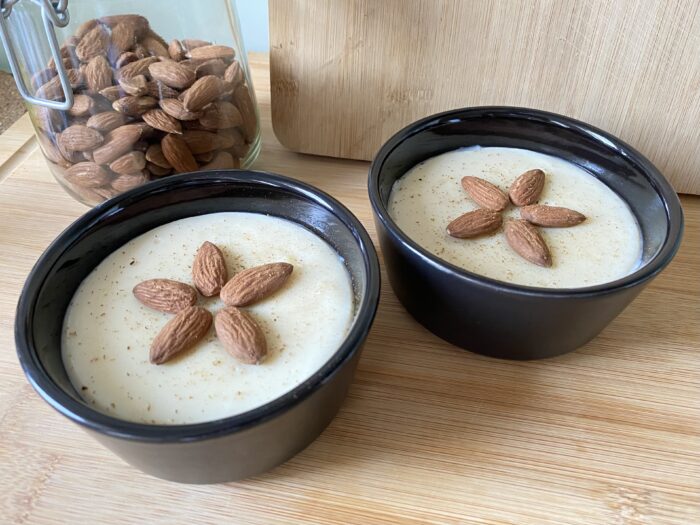
Menjablanc de Reus. Photo by Xavier Dengra licensed under CC BY-SA 4.0
Its name means “white food”, and that’s exactly what it is — a soft, pale pudding made from almond milk, sugar, lemon peel, and cinnamon. No eggs. No dairy. Just thickened almond milk, often with a little cornflour or rice flour to set it. At a glance, it resembles blancmange, but the flavour is gentler, lighter, and slightly grainy with the texture of hand-pressed almonds.
Its roots go deep. Menjablanc likely dates back to medieval times, with strong traces of Arab influence — part of a broader culinary tradition that used almond milk and aromatics in both savoury and sweet dishes. In fact, it was once more of a medicinal or fasting food than a dessert. During Lent, when animal products were forbidden, almond milk offered a nutritious alternative. This was “white food” in every sense — simple, clean, permissible.
For many, menjablanc is a dish of memory rather than appetite. Grandmothers recall it cooling in wide, shallow bowls on the windowsill. Some added a dusting of cinnamon, others poured a thin layer of burnt sugar on top, almost like a crema catalana. It wasn’t fancy. It wasn’t supposed to be. It was comfort, economy, and nourishment in one.
These days, it’s rare to see on a restaurant menu. Some pastry shops in the south — especially in Tarragona — still make it around Easter, but even there it’s fading. It’s not showy enough, not rich enough. Too plain for the modern palate. But for those who remember it, menjablanc is more than pudding. It’s childhood, religion, thrift, and tradition, all suspended in almond milk.
Orelletes: carnival’s fried secret
If you find yourself in a Catalan village in the days leading up to Carnival, listen for the sound of oil bubbling. Not from restaurants, but from home kitchens — where large pans are brought out, aprons are dusted off, and someone’s aunt or neighbour starts turning out batches of orelletes. Named for their shape — “little ears” — these thin, crisp fritters are folded, fried, and dusted with sugar, and they barely last long enough to cool.
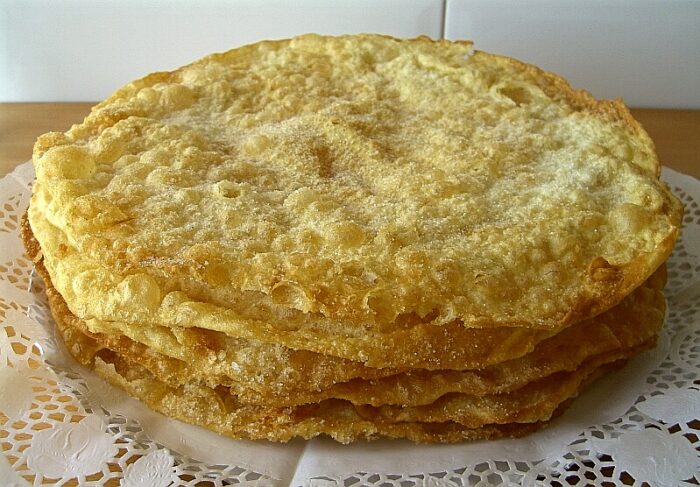
A plate of orelletes. Photo by Ramon Flix Pere is licensed under CC BY-SA 4.0
Orelletes aren’t universally known across Catalonia. You’ll find them mainly inland — in towns around Lleida, the Priorat, parts of the Terres de l’Ebre. But where they exist, they’re adored. Each family has its version. Some roll them thinner, others add lemon zest or a dash of anisette. The dough is usually a simple mix of flour, eggs, and oil, sometimes enriched with butter or lard. The key is in the frying: they puff, blister, and take on a golden colour, then get showered in sugar while still hot.
They’re made in big quantities — dozens at a time, sometimes hundreds — and meant to be shared. This is Carnival food, after all: made before Lent, when people would use up their eggs and fats in one final celebration before the lean days. It’s a tradition that has lingered in kitchens longer than in churches.
There’s something theatrical about orelletes, especially when made by someone who’s been doing it for decades. The dough is slapped, stretched, twisted. The frying is fast and hot. The kitchen fills with the sweet, faintly boozy smell of anise. Children hover, waiting for the first one to be cool enough to steal. It’s a ritual as much as a recipe.
Outside these towns, orelletes are harder to find. You might stumble on them at a local festa, or if you’re lucky, in a market where someone’s grandmother is selling them from a plastic container. They’re rarely found in bakeries and almost never in restaurants. But ask around, especially before Lent, and someone might point you to a house where the oil’s already heating.
Flaons: not all Catalan pastries come sweet
Flaons are awkward little pastries. Sweet, yes, but not sweet enough. Slightly savoury, sometimes herbal, and often filled with fresh cheese, they tend to baffle the uninitiated. One bite in and you’re not quite sure what you’re eating. Is it dessert? Is it lunch? Is that mint?
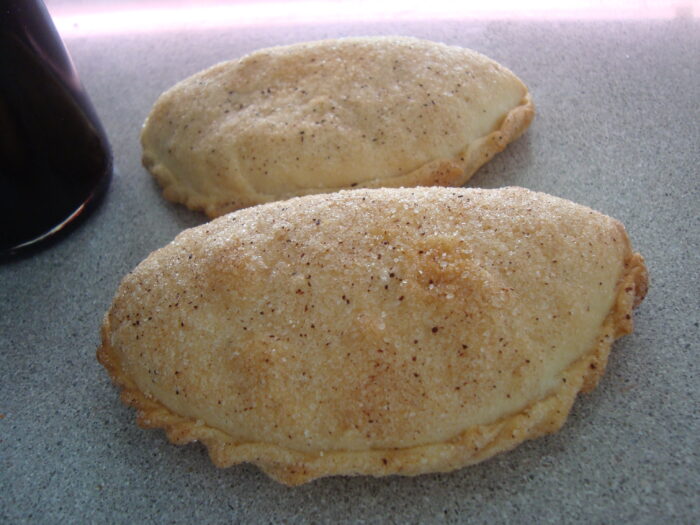
Flaons de Xert. Photo by Juan Emilio Prades Bel licensed under CC BY-SA 4.0
You’ll find flaons in several places across Catalan-speaking lands — the Empordà, parts of inland Catalonia, and the Balearic Islands, each with their own interpretation. The basic idea is a half-moon pastry, sealed and baked or fried, filled with soft cheese (mató, brossat, or even goat’s cheese), often sweetened and flavoured with something unexpected: anise, lemon zest, or fresh herbs. Mint is the most divisive — in some towns it’s traditional, in others unthinkable.
What unites them is their link to religious festivals. In the Empordà, flaons are traditionally eaten around Easter. In Ibiza, they’re a mainstay of local celebration. In some villages, they’re made en masse and given as offerings to neighbours. Their roots may lie in monastic cooking — frugal, seasonal, and practical — where cheese and herbs were plentiful, sugar was rationed, and nothing was wasted.
They don’t always go down well with outsiders. More than one visitor has been caught off guard by the herbal note or the lack of clear sweetness. But for locals, that’s the whole point. This is a pastry that doesn’t perform for the international palate. It belongs to a different rhythm — one where flavours are tied to the land, the season, and what the cows happen to be producing this week.
Most bakeries don’t sell flaons. If they do, they’re usually tucked into the corner of the display case, far from the brioches and croissants. You’ll have better luck in village pastry shops around Easter, or in places where tradition still outweighs trend. They’re not trying to be loved by everyone. They just are — unapologetically themselves.
The slow fade — and why these desserts matter
Not all traditions vanish with a bang. Some simply fade, replaced slowly by convenience, by trends, by the quiet tug of homogenisation. A new bakery opens and skips the menjablanc because no one asks for it. A chef redesigns a menu for tourists and drops the postre de músic in favour of panna cotta. And just like that, a thread is snipped. Not with outrage, not with protest — just with silence.
Catalan desserts, especially the lesser-known ones, are particularly vulnerable to this kind of slow disappearance. They don’t advertise well. They don’t photograph especially nicely. They weren’t designed for modern service or Instagram — they were made for neighbours, not customers. And yet, each one carries with it a small act of preservation: of dialect, of ingredients, of memory.
It’s not all doom. In recent years, there’s been a quiet movement — among local chefs, bakers, and food writers — to bring some of these forgotten sweets back. Not by reinventing them, but by placing them where they’ve always belonged: on the menu without explanation. Treating them as part of the everyday, not as museum pieces. You’ll sometimes see coca de vidre served with coffee in a city café, or flaons on the Easter table in Girona. It’s not a revival, exactly. More a refusal to let go.
Ask around. Look for the handwritten signs in bakery windows. Visit the older parts of town. If you see something you don’t recognise — a flat, shiny pastry, or a tub of pale pudding, or a plate of nuts beside a glass of wine — order it. Don’t worry about the recipe or whether you’ll like it. These desserts aren’t trying to impress. They’re just holding on, quietly, waiting to be remembered.
Tags: Catalan desserts, Cooking, Food