Catalan cuisine: 12 essential dishes you should know
September 2, 2025Catalan cuisine comes alive through 12 dishes that reveal its coastal roots and mountain soul.
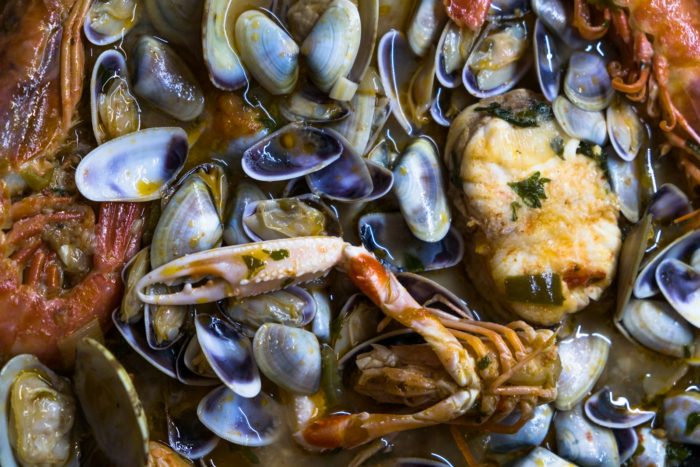
Suquet is a typical seafood dish found in Catalonia. Photo by Pau Casals
Bordered by the Pyrenees and the Mediterranean, Catalonia’s food is a natural mix of land and sea — hearty mountain stews, fire-roasted vegetables, and bold coastal dishes packed with flavour. At its heart, Catalan cooking is about balance. Sweet and savoury often appear together in the same dish. Sauces like romesco and picada are used not as decorations but as foundations of flavour. Ingredients are local, seasonal, and chosen more for quality than complexity. And unlike in some parts of Spain, meals here tend to start light and end simple — a slice of cheese with honey or a bowl of lemon-scented custard.
Whether you’re planning a trip to the Costa Brava, curious about regional Spanish food, or looking for inspiration in your own kitchen, these 12 essential dishes offer a solid introduction. Some are everyday staples, others are saved for holidays or winter Sundays, but each one tells you something about the place and the people who cook it.
1. Pa amb tomàquet
This is the foundation of Catalan cuisine — bread, tomato, olive oil, and salt. Known as pa amb tomàquet, it’s as common in Catalonia as buttered toast in Britain. The method is simple: rub ripe tomato directly onto toasted bread, drizzle with good olive oil, and sprinkle with salt. Garlic is optional but traditional, especially when paired with grilled meats or anchovies.
You’ll find it at every meal, from breakfast to dinner. It’s served as a starter, a side, or a base for toppings like ham, botifarra, or escalivada. In restaurants, it often arrives as soon as you sit down — no need to order it.
What makes it special is its flexibility and cultural weight. Everyone in Catalonia knows how to make it, and everyone has a slightly different way. It’s a dish of instinct, made with local ingredients and no strict rules — which is exactly what Catalan cooking is all about.
2. Escalivada
Named after the Catalan word escalivar, meaning “to cook in ashes”, this dish is all about smoky flavour and seasonal vegetables. Traditionally, aubergines, red peppers and onions are charred over open flames, then peeled and sliced into soft, smoky strips.
Escalivada is usually served at room temperature, dressed with olive oil and sometimes topped with anchovies or black olives. It works on its own as a starter, or spooned onto pa amb tomàquet as a topping. You’ll also see it as part of a torrada — a slice of toasted bread loaded with savoury ingredients.
It’s a good example of Catalan cooking’s respect for simplicity: take a few good vegetables, roast them until sweet and smoky, and let them speak for themselves. It’s often made ahead of time and kept in the fridge — even better the next day.
3. Botifarra amb mongetes
This is proper Catalan comfort food: thick pork sausage grilled and served with creamy white beans, often drizzled with olive oil or cooked in the meat’s juices. It’s a simple farmhouse dish that’s never gone out of style.
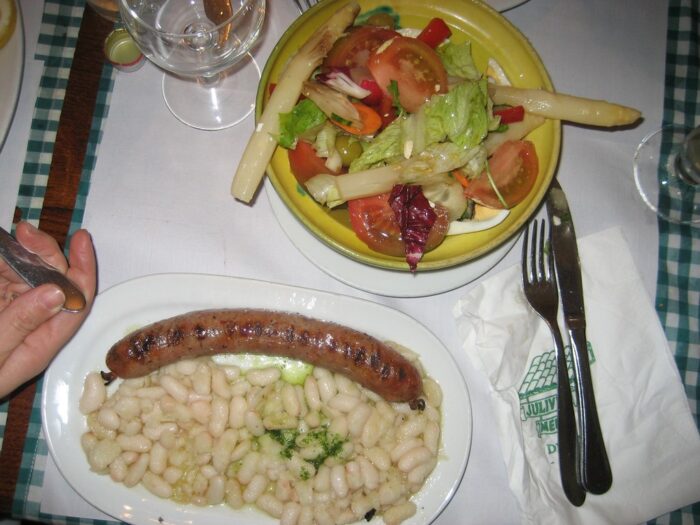
The sausage, botifarra, comes in several types — fresh (botifarra crua), black (botifarra negra), and even versions with truffle, mushrooms or egg. For this dish, the fresh variety is usually used, grilled until crisp on the outside and juicy inside. The beans (mongetes del ganxet) are local to the region — soft, small and slightly nutty.
You’ll find this in traditional restaurants, roadside diners and home kitchens all over Catalonia. It’s hearty, no-nonsense food — the kind you crave after a long walk or a cold day. There’s nothing fancy about it, and that’s exactly the point.
4. Fideuà
Think of fideuà as paella’s Catalan cousin — but with short pasta instead of rice. Originating from the Valencian coastal town of Gandia and adopted widely along the Costa Brava, it’s typically made with noodles, fish stock, squid, prawns, and sometimes clams or cuttlefish.
The pasta is toasted lightly before cooking, giving it a nutty flavour, and it’s often finished in the oven to create a crisp top. The result is rich, savoury and slightly chewy — very different from anything you’d find elsewhere in Spain.
Fideuà is usually served with a generous dollop of allioli (traditionally garlic and oil emulsion, but more often a garlicky mayonnaise), which cuts through the seafood and brings everything together. It’s a staple in seaside restaurants and a favourite for Sunday family meals, especially in fishing towns.
5. Esqueixada
Esqueixada is a fresh, tangy salad made with shredded salt cod, tomatoes, onions, olives and sometimes green peppers. Served cold, it’s especially popular in summer, offering a sharp contrast to the richer stews and grilled meats of Catalan cuisine.
The name comes from esqueixar, meaning “to tear” — the cod is never cut with a knife, but hand-shredded into delicate flakes. The fish is soaked to remove excess salt, then mixed with ripe tomatoes, thinly sliced onion and plenty of olive oil. Black olives are common; hard-boiled egg is an occasional extra.
It’s a dish that feels light but packed with flavour — a favourite on restaurant menus and a common starter at home. If pa amb tomàquet is the Catalan answer to toast, esqueixada is its version of ceviche — simple, honest, and tied to the coast.
6. Suquet de peix
Suquet de peix is a traditional Catalan fish stew born from the boats — a dish fishermen would cook onboard using the day’s unsellable catch. It’s rustic, rich, and deeply tied to the coastal identity of Catalonia.
The base is a simple sofregit of garlic, tomato and olive oil, enriched with fish stock, potatoes and a blend of white fish and shellfish — often monkfish, hake, mussels or prawns. Some versions add a picada (a ground mixture of nuts, bread, garlic and parsley) to thicken the broth and intensify the flavour.
You’ll find suquet served in seaside restaurants all along the Costa Brava, often in heavy clay pots that keep it bubbling at the table. It’s not flashy, but it’s the kind of dish that lingers — full of depth, and unmistakably local.
7. Canelons
Canelons might sound Italian, and they are — but in Catalonia, they’ve taken on a life of their own. Introduced in the 19th century, they’ve become a classic dish for Boxing Day (Dia de Sant Esteve), made to use up leftovers from Christmas.
The pasta tubes are filled with a finely chopped mixture of roast meat — often a blend of pork, beef and poultry — bound with béchamel or liver pâté. They’re topped with more béchamel, sprinkled with cheese, and baked until golden and bubbling.
While they appear on restaurant menus year-round, canelons are most firmly rooted in home cooking and holiday tradition. It’s one of those dishes where every family claims theirs is the best — and none of them are wrong.
8. Calçots with salvitxada
This dish is more than just food — it’s a seasonal event. Calçots are a type of spring onion, grown mainly in southern Catalonia in the region around Valls, and eaten in winter and early spring at outdoor gatherings called calçotades.
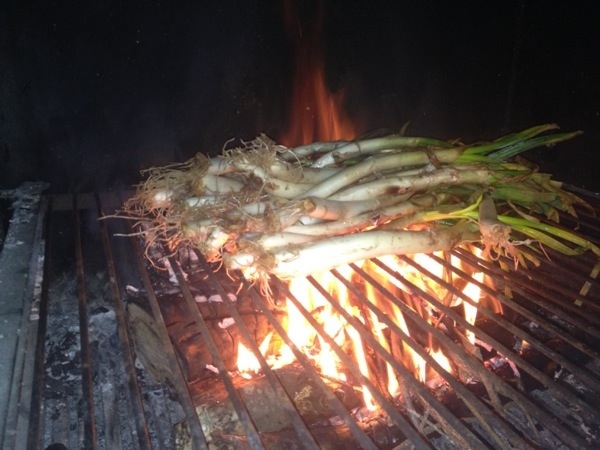
Calçots cooking on an open fire. Photo by David Leigh
The calçots are grilled over open flames until blackened on the outside and tender inside. Diners peel away the charred outer layers, dip the juicy inner stem into salvitxada or romesco sauce — made from roasted red peppers, almonds, garlic and olive oil — and tip them back like a sword into the mouth. It’s messy, hands-on eating, usually accompanied by grilled meats and plenty of red wine.
For many Catalans, a calçotada marks the end of winter and the start of longer days. Even if you’re not in Valls, you’ll find calçots on menus across Catalonia from January to March — but it’s best enjoyed outdoors, with a bib, a napkin, and a big appetite.
9. Mar i muntanya
Mar i muntanya — “sea and mountain” — is more than a dish; it’s a whole category of Catalan cooking. It brings together ingredients from the coast and the inland hills in combinations that might seem odd at first but make perfect sense on the plate.
A classic example is chicken with prawns, slow-cooked in a tomato and onion base, sometimes finished with a picada. Other versions use rabbit with lobster, or cuttlefish with meatballs. The idea is balance — the richness of meat softened by the sweetness of shellfish, with a savoury depth that speaks of both land and sea.
It’s a style of cooking that captures Catalonia’s geography in a single pan — mountains behind you, the sea in front — and it’s still a favourite at Sunday lunches and special occasions.
10. Fricandó
Fricandó is a slow-cooked veal stew that feels deeply Catalan — earthy, comforting and made for autumn. Thin slices of beef or veal are browned and simmered in a sauce of white wine, onions and tomato, often finished with wild mushrooms like moixernons or rovellons, depending on the season.
Like many Catalan stews, fricandó is often enriched with a picada to thicken the sauce and add extra flavour. It’s a dish you’re more likely to find in homes than restaurants, although some old-style eateries still keep it on the menu.
Served with bread to mop up the sauce, it’s not a showy plate — but when done right, it’s one of the most satisfying.
11. Crema Catalana
Crema Catalana is Catalonia’s most famous dessert — a smooth custard infused with lemon zest and cinnamon, topped with a layer of burnt sugar that cracks under the spoon. Though often compared to crème brûlée, it’s lighter, a touch spicier, and — as many Catalans will point out — probably older.
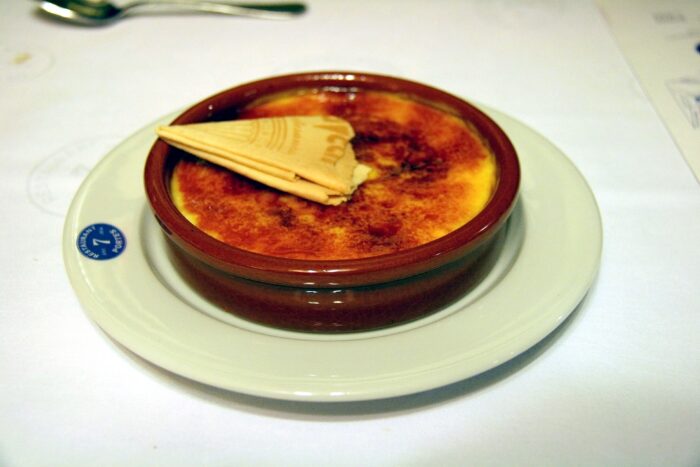
Traditionally made on Saint Joseph’s Day (19th March), it’s now a year-round favourite in restaurants and homes alike. Unlike its French cousin, crema Catalana is made with milk instead of cream, giving it a more delicate texture. The sugar is caramelised with a hot iron, though a blowtorch does the job these days.
It’s a quiet sort of dessert — nothing extravagant — but it’s often the thing people remember most at the end of a Catalan meal.
12. Mel i mató
Mel i mató is as simple as desserts come: fresh, unsalted cheese (mató) drizzled with honey. That’s it — no pastry, no baking, no garnish beyond maybe a few walnuts. But when the cheese is fresh and the honey local, it’s just right.
Mató is a soft curd cheese, similar to ricotta but milder. It’s made from cow’s or goat’s milk, with a slightly grainy texture and a clean, milky taste. It’s often served chilled, making it a light, refreshing end to a meal — especially after heavier dishes like botifarra or fricandó.
This is the kind of dessert you’ll find in rural restaurants, especially inland, and it sums up a lot about Catalan cooking: good ingredients, nothing wasted, and no need to show off.
The Catalan table
Catalan cuisine isn’t about complexity — it’s about knowing what to do with what you have. Whether it’s bread and tomato or a stew passed down for generations, the food here tells you something about the people who make it: practical, proud of their traditions, and serious about flavour.
These twelve dishes only scratch the surface, but they offer a starting point. Try them in a simple bar by the sea or in a family-run restaurant up in the hills. Cook a few at home. Learn what goes into a romesco or a picada, and you’ll start to see how Catalan food fits together — one plate at a time.